Interview: Performance Management Design for Organizational Change

March 2, 2010

This morning on The Change Agent’s Dilemma radio show, I interviewed Dr. Janet Hecht of Talent by Design Consulting, LLC about how to design a performance management system for organizational change.

Janet shared the components of an effective performance management design and the tips she learned as an employee implementing a performance management system to 55,000 associates at the State of Georgia.  She also warned of some of the pitfalls to avoid when designing and implementing a performance management system.

Listen here (30 minutes):

Be sure to visit the new radio show page to find other ways you can tune in to the show.

Monitor Your Organization’s “Non-Verbal” Communication

February 23, 2010

It is widely cited that verbal communication makes up only 7% of a total message during a conversation.  That is, 93% percent of the meaning within the conversation comes from outside the words that we use.  These non-verbal aspects of communication include gestures, posture, intonation, and facial expressions.  It turns out the concrete language is by far the least important factor in our interpretation and understanding of what the other person saying.

A similar phenomenon happens in organizations.  Consider that the equivalent to verbal communication in organizations are the formal words that come to employees in the form of official documents:  values and mission statements, strategy, policies, newsletters, websites, announcements, press releases, and other communication devices. The rest of internal communication comes from everything else employees experience.  Similar to a conversation, the vast majority of meaning and understanding is generated by “non-verbal” communication.

The following are examples of “non-verbal” communication in organizations that speak louder than words:

Accountability

Employees assess which policies count and which ones are merely guidelines based on how consistently they are enforced.  Processes and procedures are generally followed to the extent that they are required.

“Everyone must contact the IT helpdesk to resolve computer issues”
(unless you know who to call to avoid waiting).

Rewards

Rewards in all their forms tell employees how to be successful.  Traditional incentive programs signal expectations but may conflict with stated values or even inadvertently motivate a different behavior than what is desired.  Furthermore, who gets promoted and what behaviors elicit praise send powerful messages about what is expected.

“Safety first!”
(Here’s your efficiency bonus.)

Decisions

How managers spend resources speaks volumes about what they truly value and prioritize.  The decisions they make about how to allocate funds and how they spend their own time demonstrates what they believe will lead to success.

“Strategic initiatives are important”
(until we need to cut something out of the budget).

Management behavior

More than anything, employees look at the behavior modeled by management to see if it matches what is officially communicated.  The most influential person in this regard is an employee’s own boss.  The attitudes and behaviors displayed by people in authority tell the real story of what is expected.

“We value employees’ ideas”
(but not the terrible one you just shared).

Employees will rely on “non-verbal” communication to understand what is expected and to decide appropriate action in the midst of uncertainty. When introduced to news of change, many employees will take the stance, “I’ll believe it when I see it.”  It is not enough for them to hear it or read it.   It is imperative to monitor your organization’s “non-verbal” communication to ensure that actions and behaviors are consistent with your official change message.

Interview: Make Personal Accountability a Core Value

February 16, 2010

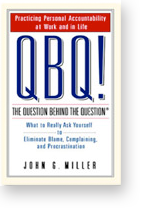
qbq-bookThis morning I interviewed John G. Miller, bestselling author of QBQ: The Question Behind the Question and Flipping The Switch as well as the new book Outstanding! 47 Ways to Make Your Organization Exceptional, on my biweekly radio show, The Change Agent’s Dilemma.  The topic was “Make Personal Accountability a Core Value Using the QBQ.”

During the show, John shared his methodology for eliminating blame, complaining and procrastination.  He also talked about the two myths of accountability and much more!

Listen here (30 minutes):

If you are a podcast listener, you may also subscribe to The Change Agent’s Dilemma on iTunes.

Ten Essential Tools for Change Agents

February 2, 2010

Change agents are individuals within organizations who influence change without having direct authority over people who are going through the change.  The following are ten things that effective change agents use to influence change in their organizations. Read more

Interview: Creating Alignment with Four Questions

January 19, 2010

This morning I hosted an interview with Jeff Lebow, Co-founder and Principal Consultant of Alignment at Work, LLC, on my biweekly radio show, The Change Agent’s Dilemma.  The topic was “Create Alignment with Four Questions.”

During the show, Jeff shared what alignment is, how it relates to accountability, and how you achieve it.  The key is to gain agreement on the answers to The Four Pull QuestionsSM.

Among my favorite quotes from our discussion is “What goes without saying doesn’t always go.”

Listen here (30 minutes):

If you are a podcast listener, you may also subscribe to The Change Agent’s Dilemma on iTunes.

The first step toward change

January 13, 2010

When you want something to change, the first thing you need to do is stop complaining about it.

You may not truly whine about it; complaining takes many forms.  Perhaps you lament about it with your colleagues at lunch, or even work yourself into a loathsome frenzy about who is to blame.  You might lead an educated discussion in a meeting about why the current way doesn’t work.  If all you do is point out the problem or the thing that needs changing, you’re complaining.

Complaining is passive.  It assumes no responsibility, and seeks blame.  Complaining means it’s someone else’s job to fix it.

Complaining about wanting something to change usually involves criticizing other people (especially leadership):  their inability to change, or their cluelessness about the problem, or their unwillingness to do something about it.  While popular and cathartic, complaining about others does nothing to solve the problem.  In fact it contributes to your becoming known as someone who talks behind others’ backs – leading to a serious erosion of integrity.

Complaining also locks you into a specific mindset that affects your own willingness to act.  A lot of time and energy is spent watching for confirmation of your complaint and seeking acknowledgment from others that they agree with your assessment.  You stop noticing evidence that change is possible and ignore opportunities to make a difference.

When you stop complaining a marvelous thing happens.  Without an outlet for all the negative information, you stop collecting it.  All the attention spent on proving the problem can now be focused on something infinitely more effective:  finding a path to the solution.

If you truly want to see something change, choose to view the situation as changeable.  Make the conscious decision to stop complaining about what is.  Open yourself up to the possibility that it doesn’t have to be that way, and that you can have a hand in making it better.

Guest Blog Post: Infallibility

August 10, 2009

By Robert Gold

Everyone makes mistakes – we often say that ‘to err is human, to forgive divine.’ And despite occasional assertions to the contrary, our leaders are in fact human. So our leaders have made mistakes, and will continue to do so for the foreseeable future.

The consequences of our leaders’ mistakes are usually greater than the mistakes of those led; through their decisions and actions, leaders cause many others to do things. This is the definition of leadership. In meritocracies, individuals rise to leadership roles because they are viewed as capable and skillful, and are therefore expected to make good decisions for the organizations they lead. But we also say that ‘mistakes will happen.’

About a week ago, U.S. President Barack Obama made a comment at a press conference (about the racially-charged arrest of a noted college professor) that exploded into a firestorm of popular and media criticism. In an unscheduled press appearance a few days later, he somewhat clumsily acknowledged his error, and has since arranged to sit down for a beer with the professor and police officer involved. His admission was kind of a refreshing moment. In his remarks, Obama said that he hoped the episode would become a ‘teachable moment,’ presumably on the topic of race at the center of the incident. Perhaps it can be a teachable moment here, as well.

We properly hold our leaders to a higher standard when it comes to their errors; we want errors to happen infrequently, we want leaders to be motivated to avoid errors, we want errors to be quickly rectified. We want confidence that our leaders’ directions will lead to good outcomes for ourselves. Leaders with too many errors don’t always get to keep their jobs, especially when financial performance and stock price reflect the consequences of those errors.

Leaders face a dilemma when they err – to avoid the appearance of fallibility so as to sustain a perception of error-free performance, or to acknowledge their error and risk losing the support and trust of those they lead. All too often, leaders find it more attractive to try to be seen as error-free.

Many of the organizations I’ve worked with have become dysfunctional over time because of this approach to error. Their leaders are willing (sometimes even relieved) to unburden themselves of their misdeeds behind closed doors, but are simply unable to do so in a public setting. The members of these organizations are aware of the mistakes, but fear retribution from raising any public discussion of the errors. Thus, leaders and the led enable each other to sustain a fictional parallel universe in which everything is (and will continue to be) hunky-dory. It is unsurprising when these leaders finally do go away, and only a short time before a new parallel universe is constructed around the next regime.

But other organizations have a healthier culture in which errors are expected and handled as part of normal routine. Leaders freely admit their mistakes and are open to criticism. Willingness to quickly identify problems and to focus on corrective action rather than blame means that the impact of errors is lessened. Contrary to intuition, employees trust and are loyal to their fallible leaders more than those who attempt to appear infallible.

Strategy is about setting a direction for an uncertain future. Errors will be made. Hypotheses will be more quickly proven or disproven when leaders expect to be wrong, and course corrections can easily be made. But how often have you heard your leader say, “I made a mistake, and I was wrong. Let’s move on.” ? Have there been teachable moments in your organization? Please share your comments below.

Guest Blog Author: Robert Gold

Robert S. Gold brings over three decades of professional experience to his role as founder and thought leader of Tenacious Tortoise, LLC.

This post was originally published at the Tenacious Tortoise blog. Reprinted with permission.

A common picture of the ideal organization

May 18, 2009

Even though organizations have different purposes and strategies, I think we tend to have a common picture of the ideal characteristics of an effective organization. I wonder if these are the things you are trying to bring about in your organization:

  • Multi-directional trust (leadership, employees, peers)
  • Transparency and feedback
  • Ample, clear, compelling, consistent communication
  • High-performing teams
  • Data-based decisions
  • Accountability to results
  • Clarity of vision
  • Congruence of personal work with organizational goals
  • Alignment between business units and departments
  • Breakdown of silos, turf wars, and self-protection
  • Atmosphere of mutual respect
  • Employee engagement
  • The idea of a “well-oiled machine”, efficient standardized processes
  • Effective, value-added meetings

I would love to hear what else you might add to this list, and if any of these would actually decrease your success.  Please share using the comments.

How to deal with a clueless boss

March 2, 2009

I recently answered the following question on LinkedIn:

How do you (convincingly pretend) to listen and respect your Pointy Haired Boss?  How do you hide the fact that you are thinking “my God, you are so clueless yet so oblivious to it”?

Name-calling aside, it is easy to identify with the author’s plight.  Who among us has not had the same thought at one time or another (or for years at a time!)?

Most answers up to that point advised him to either quit as soon as possible or just grin and bear it.  The following was my brief response:

Consider that you are contributing to his cluelessness if you are not providing constructive feedback. Instead of asking how you hide it, perhaps the question to ask is “How do you respectfully inform your boss that s/he is negatively affecting your or your company’s performance?”

I’m guessing that’s not the response he was looking for when he asked the question, but he probably wasn’t satisfied with the other two options either.

Sure, he could quit, but what if he really enjoys his work and his coworkers, and doesn’t want to leave the company?  Besides, what happens next time he finds himself in the same situation?

The “grin and bear it” solution creates a pressure-cooker scenario.  Accepting the situation as-is does nothing to solve what is most likely a real problem.  It is not going to fix itself.

So, if addressing the issue is the best solution, how do you respectfully inform your boss that he is negatively affecting your or the company’s performance?  Follow these steps:

  1. Stop the name-calling and talking behind his back about it (and griping on public forums!).  It only serves to destroy your own integrity, and it fuels your rage.
  2. Realize that the “clueless” leader is the norm, not the outlier.  The higher up in the organization you are, the less people tell you what you don’t want to hear.  And you don’t notice the change.
  3. Get clear about what the real issue is.  If you’ve been working with this boss for a while, chances are that everything he says is annoying.  Take a step back to understand what really needs to be addressed.  If it still seems like a lot of things, choose the most important.  You don’t want to generate a laundry list or it will seem like an attack.
  4. Make sure you are in the right frame of mind for an effective conversation.  Approach it with a genuine perspective that you are trying to help your boss, or at least doing the best thing for the company.  If you go into the conversation seeking to right a wrong or to exact some kind of revenge, not only will your boss be more defensive during the conversation, but it will be more awkward afterward.
  5. Plan when you will have the conversation.  You don’t necessarily have to schedule it with your boss, but know ahead of time for yourself when and where you will talk.
  6. At the beginning of the conversation, ask permission to give the feedback.  It is unlikely that he will say “no,” and after saying “yes” he at least needs to hear what you have to say.
  7. Unless you have permission to represent a group, don’t drag other people into it. It might be comfortable to make yourself seem like one of many, but from the boss’s point of view, that’s a mutiny.
  8. Be honest and direct.  Tell your boss the experience from your perspective, and what the implications are.  Use specific examples.
  9. Expect your boss to be defensive.  He may deny it or even turn it around to be your own fault.  Don’t become defensive yourself.  If you feel that you’ve made your case, thank him for letting you share your perspective and politely end the conversation.
  10. Thank him for listening (even if it seems like he didn’t).  If the conversation went well, ask how you can best follow up.

Perhaps it’s not your boss who needs his mirror polished.  As an organizational change agent, you know the leaders who need to change their own behavior to make the initiative successful.  If you are not having these conversations, who is?

If you need to have a conversation like this, but you struggle with the best approach, please contact me and we’ll talk through it.

Feedback lessons from American Idol

February 3, 2009

Like millions of others, I enjoy American Idol, but usually only after they get to Hollywood, when they are done filtering through the bad singers.  Last week, although they were still in the preliminary phase, I thought I would watch with an eye for feedback tips.

Lesson #1:  Short of honest feedback, people assume the best of their own performance.

A friend tried out for American Idol a couple of years ago, and shared her experience. Evidently, there are several rounds of auditions with other judges before the final round with Randy, Paula, and Simon (and now Kara).  Which means that that the judges in previous rounds passed all the bad singers and crazy personalities by allowing them to think they were good enough to go on to the next round.  If you think about it, this is not much different from every day at work.  Lack of feedback – or lack of honest feedback – allows individuals to go on thinking that their bad behavior is acceptable and effective.

Lesson #2:  Request permission to provide feedback before giving it.

The people who try out for American Idol expect to be given feedback, even though they may not agree with it.  Otherwise, they stay home. If they sign up for it, they have to listen, or at least stand there while you say it.

Lesson #3:  Modify your approach based on the performance and their attitude.

Watching Simon Cowell give feedback, I noticed he has four different approaches.

  1. Beaming praise.  When someone deserves it, he doesn’t hold back the good feedback.
  2. Genuine critique.  Contestants that have talent but need to work at improving receive kind words and specific suggestions.
  3. Confirmation of doubt.  When the contestant is not good but also not in denial, Simon says something like, “That wasn’t good enough, now was it?”  He lets them down somewhat easily by simply confirming what they already know.
  4. Direct and rude.  For contestants who believe they are destined to be stars but who are truly untalented, Simon provides the response he has become famous for:  direct, rude, and insulting.  He tries to knock these contestants down a notch to bring them into reality, and if that doesn’t work, at least it makes for good television.

I’m not a proponent of being rude and insulting, but being direct does have its place.  In my experience, the immediate response to direct, honest feedback is usually defensive and denial, but the recipient usually does listen in the end.

Next Page »

Hear the latest episode of The Change Agent’s Dilemma:

Let’s Connect!

Follow me on TwitterConnect on LinkedInBecome a Fan on FacebookEmail me

Free 30-Page Workbook!

Sign up for the monthly newsletter and get the Change Starts Here Workbook!
Email
First Name
Last Name
See preview. View the privacy policy.