Unconventional advice to weather the storm
October 28, 2009
Last week I hosted an interesting discussion with a group of strategy management professionals. The topic was open, but it turns out most had the same general theme in mind: how to keep a focus on strategy and change during times of turmoil.
The scenarios were different but the challenge was the same. Whether the organization was suffering from the recession, or undergoing a merger, or experiencing a change in leadership, the common question was: “How do we maintain continuity of strategy and long term focus when our people are focused on short term survival?”
Leadership and change theory would suggest to double-down on the vision at that point. Keep your eye on the future so you can make sure you’re still headed in the right direction. Beat the strategy drum so everyone knows it’s still important.
The advice that bubbled up from the group, however, was different. As change agents and strategy practitioners, they were not in executive leadership positions. From their perspective, the best thing to do was to help the organization focus on the right short-term efforts. If everyone was going to be stuck in the present, then they should stay there too and not fight it.
By maintaining focus on the projects and initiatives that were developed to implement the strategy, the group felt they would better be able to weather the storm. Behind the scenes, they would continue to make sure projects were linked to the long-term strategy.
What is your experience making sure your change initiative survived turmoil? What advice would you give?
A common picture of the ideal organization
May 18, 2009
Even though organizations have different purposes and strategies, I think we tend to have a common picture of the ideal characteristics of an effective organization. I wonder if these are the things you are trying to bring about in your organization:
- Multi-directional trust (leadership, employees, peers)
- Transparency and feedback
- Ample, clear, compelling, consistent communication
- High-performing teams
- Data-based decisions
- Accountability to results
- Clarity of vision
- Congruence of personal work with organizational goals
- Alignment between business units and departments
- Breakdown of silos, turf wars, and self-protection
- Atmosphere of mutual respect
- Employee engagement
- The idea of a “well-oiled machine”, efficient standardized processes
- Effective, value-added meetings
I would love to hear what else you might add to this list, and if any of these would actually decrease your success. Please share using the comments.
Strategy Map Template
April 24, 2009
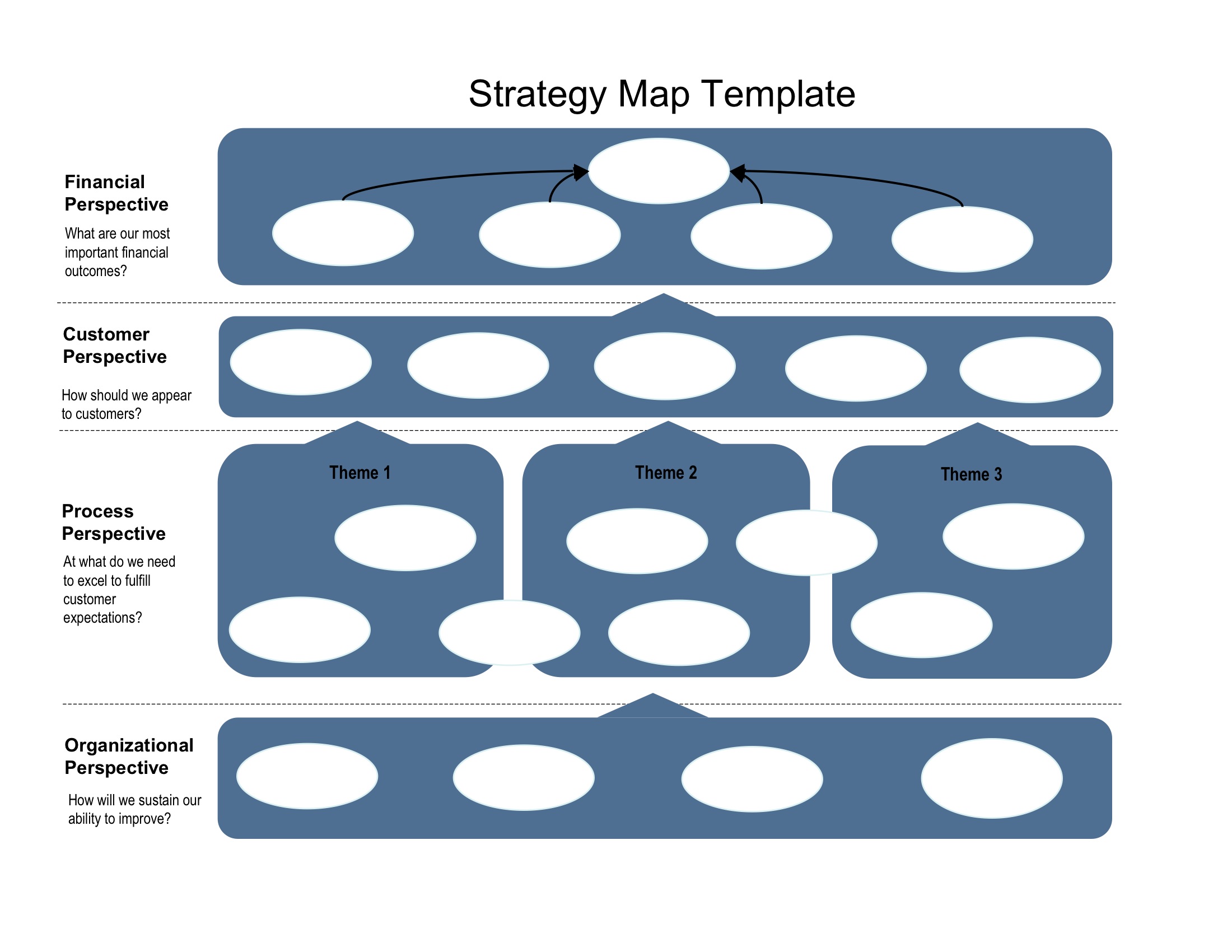
It’s been a while since I’ve posted a template. I’m in the process of helping the Organization Change Alliance with their strategy map, so I thought I would post the generic template we started with.
A strategy map is a one-page visual representation of an organization’s strategy. It originates from the Balanced Scorecard methodology, so it consists of the four BSC perspectives: Financial, Customer, Process, and Learning/Growth. The “bubbles” are placeholders for objectives – individual pieces of the strategy, like “Maximize marketing effectiveness” or “Create enthusiastic customers.” The objectives answer what success looks like from each perspective. Themes, usually in the Process perspective, are groups of objectives with the same general, well, theme.
The template is in PowerPoint format. Feel free to modify as you wish, and contact me if you would like some help.
As someone with an interest in Balanced Scorecard, you may also be interested in:
- Case Study: A Fizzled Balanced Scorecard Implementation
- Tips for Leading a Successful Transformation
Blue Ocean change strategy
March 25, 2009
At a recent meeting of the Atlanta chapter of the Association for Strategic Planning (ASP), I heard a presentation on the basics of Blue Ocean Strategy, and thought the concept might be interesting when focused inward on an organization.
The premise behind Blue Ocean Strategy is that your current market of customers is only a subset of the customers who potentially need or want your product or service. The current market is called a Red Ocean because of all the competition tearing each other apart. The Blue Ocean represents all the potential customers who are not currently buying because they don’t have any idea what your product or service does or why they might need it.
The solution presented for engaging the Blue Ocean was through Value Innovation. The simplified method included finding the answers to these questions:
- What causes people not to buy this product?
- What can we do to overcome it? (What can we reduce, raise, eliminate or create?)
When you look at your organizational change initiative, you might see a similar pattern. There is a subset of the organization who “gets it,” pays attention, and is involved in making progress. And then there is everyone else, who is not buying what you’re selling. Not only that, but it’s not even on their radar.
Inquiry: What causes people to not to “buy” your change?
There are a number of other tools in the Blue Ocean Strategy framework that might be helpful to expand your thinking along these lines. Visit the official Blue Ocean Strategy site for some useful diagrams and more detailed concepts.
Podcast #3: The indispensible change agent
March 10, 2009
The Enclaria podcast series features interviews with change agents. Hear how others overcome obstacles while they pass along lessons learned from their organizational change experiences.
As the Senior Manager of Strategy Management Performance Excellence in a large IT department within a much larger corporation, Pamela Santiago has built a team that has become a center of excellence in change management and strategy execution within the larger organization. Her story also shows how change can start within a support unit as a proving ground, then branch out into the rest of the company. Listen for insights on what makes a successful change agent and change management team.
Case Study: A Fizzled Balanced Scorecard Implementation
March 5, 2009
In the history of Balanced Scorecard implementations and organizational change in general, stories of projects falling by the wayside are numerous. Even organizations that have had great success and demonstrated breakthrough results have fallen away from the methodology, either due to a change in leadership or from the initiative growing stale. In the case of The Jel Sert Company, a mid-size food manufacturer based in West Chicago, Illinois, the project never quite gained the traction it needed to sustain itself, and the leadership team made the conscious decision to end it. Read more
Podcast #1: A new intrapreneur reflects on large-scale transformation
January 6, 2009
The Enclaria podcast series features interviews with change agents. Hear how others break through obstacles while they pass along lessons learned from their organizational change endeavors.
Nine months ago, Jim Ryan, Manager of Strategic Planning at Embarq Corporation, changed roles within the Fortune 500 telecommunications company. Although he kept his job title, his role morphed from implementing strategy – developing strategy, creating measures and scorecards, and rolling out the plan to the organization – to implementing one of the strategic initiatives – creating an entirely new business from scratch within the same organization. From his new vantage point as an intrapreneur, he describes the differences between implementing change within an existing large company and building a new internal venture.
Little blue notebook
December 11, 2008
When I was a fledgling change agent, I kept a little blue notebook hidden in my purse. It was a Mead Five-Star Fat Lil’ Notebook. Inside were one-page observations, comments, quotes and complaints that reflected what I felt needed to be fixed at the company where I worked. It’s probably a good thing that blogs hadn’t been invented yet.
I still have it. Here are a few excerpts:
CULTURE
Lack of follow through. We are good at identifying problems but frequently push them aside to focus on other things. Sometimes we even know the solution and don’t follow through.
INCENTIVES
Sales managers are given a bonus based on accuracy of the total number of cases. The customer of the forecast is the planning department. Total number of cases does not help them plan better. Reward the desired behavior – some measure of SKU or category forecast accuracy.
LEADERSHIP
No one can say anything in front of [name]. He should not be the end of the line final decision maker. Does he know people are closed-mouthed around him? His decisions sometimes are reversed at meetings he doesn’t attend.
STRATEGY
What is our strategy? To sell to anyone who will buy? Why are we not more discriminating in what we sell? What is the process that makes us continue to try to sell every combination of goods?
The notebook served a few purposes.
- A record – it’s easy to lose sight of things that need to be fixed when you either get used to them or move on to something else. Writing it down preserves the memory, and you can go back and count the number of instances something is mentioned to measure its importance (forecast accuracy was a big deal).
- An outlet – you can tell by the tone of some of the comments that I was mad or annoyed. Writing was a way to vent the negative emotion. It can also help clarify what is the crux of the problem.
- An integrity-keeper – writing down your thoughts privately can help you refrain from complaining to others. According to The Transparency Edge, one of the books in my reading list, one way to destroy your integrity is with unproductive criticism or complaining. (Of course, if someone had found the little blue notebook, that would have been another story.)
Granted, I was not able to fix everything on the list, but I was able to take a stab at some of it. And that’s really my point. Don’t keep a journal like this just to document the list of everything you don’t like about your company. Write with the best intentions to take action and improve the important things.
Inquiry: What’s in your little blue notebook? What are you going to do about it?
Tips for Leading a Successful Transformation
February 1, 2008
Once a year, over one hundred former employees of AT&T Canada Long Distance Services get together to celebrate a major accomplishment. Ten years ago, they brought the company back from the brink. How do you lead an organizational transformation that has such an impact that those involved are still celebrating it together ten years later? Bill Catucci, former CEO of AT&T Canada LDS reveals that it is a combination of actions and leadership. Read more