Ten Essential Tools for Change Agents
February 2, 2010
Change agents are individuals within organizations who influence change without having direct authority over people who are going through the change. The following are ten things that effective change agents use to influence change in their organizations. Read more
Change agents are leaders
January 21, 2010
Yesterday I talked about how leaders are not change agents, pointing out a difference in roles between individuals who have authority within a change initiative, and those who don’t.
While people who are in leadership positions are not the same as the people who are change agents, change agents themselves must demonstrate leadership qualities to be effective. In that sense, change agents are leaders.
Because trust is essential for change agents, the same standards of integrity and credibility apply.
To gain buy-in, change agents consistently communicate the vision and purpose of the initiative.
Change agents frequently gain their own tribe of followers who also believe in the vision and want to be involved.
Savvy change agents may even be leading the leaders!
The tagline for Enclaria is “Equipping individuals to lead organizational change.” I frequently add “from the middle” in conversations, because my focus is building up the capability of change agents to influence their organizations. To that end, I believe it is important to distinguish between the leadership position in a change initiative, and the leadership characteristics that change agents must have to increase their power and influence.
If this post was useful, you may also enjoy:
Leaders are not change agents
January 20, 2010
Leaders are not change agents. They are leaders! Leaders and change agents hold two separate positions within an organizational change initiative.
Leaders have power and authority within their organizations primarily due to their position. They are able to hold people accountable for changing their behaviors and activities. The organization watches and listens to leaders to see what is true and what is expected.
Change agents, on the other hand, need to enlist leaders to help them make change happen. As a change agent, you do not have the same authority to get things done as leaders. Instead you rely on your ability to influence the organization indirectly. Leaders look to change agents to do the legwork.
This difference does not mean that a senior manager or executive cannot be the change agent for an initiative. The change agent role is not defined by position, but by the relationships to the leader of the change initiative and to those going through the change. You can be a leader within your own department and still be a change agent for a broader initiative (think IT, Strategic Planning, Lean Six Sigma, Communications, Organization Development, etc.).
With which role do you identify the most?
Stay tuned for tomorrow’s post: Change agents are leaders.
The birth of a part-time change agent
September 17, 2009
In my own story of organizational change as well as the stories of others, being a change agent started out as a part-time thing. Sometimes you realize that in order to effectively perform your day job, organizational changes need to happen so you take them on. Sometimes the opportunities you see are outside the scope of your job, so you try to get involved. Either way, you can’t just give up your “day job” to start working full time as a change agent.
I’ve recently talked to a salesperson and an IT system administrator who both see opportunities and have hopes of implementing organizational change within their companies, but at the moment, it’s not in their job description.
What are they doing to get started as a change agent?
The salesperson has contacted the corporate Organization Development function to let them know she is interested in that type of work, so when something needs to be done in her division, they might be able to involve her. She has identified that silos exist in her division, and she’s dedicated to figuring out how to influence improvements within the scope of her own job.
The IT system administrator would like to develop a centralized system that would change the way the company uses information. The project is out of the scope of his current job. He wrote up a proposal for the system that has been passed around at higher levels, and he made a presentation at a company conference. Now he’s starting to set up meetings with influential leaders in the company to try to build buy-in for his idea.
How did you get started as a change agent (or what are you doing to start)? I would love to hear your stories.
The Dance of Change
August 24, 2009
I’ve been thinking about how despite our better intentions, changing organizations is never predictable, and doesn’t perfectly fit into a nice theoretical model the way we wish it would.
As change agents, we frequently Dance in the Moment (a term I learned a few years ago in the CTI coaching program). While we work toward an envisioned future, we can only handle what is right in front of us, which is constantly shifting based on the reactions to the strategies we’re using to try to influence change.
If you think of the process of change as a dance, you realize it’s a partnership between two entities. Even if you haven’t taken ballroom dancing classes (or watched Dancing With the Stars), you probably know that each person in the duo has a specific role: leader and follower.
A few of the moves that the leader does to show the follower where to go are overt gestures that can be observed from the audience. However, most of the time the follower just seems like she knows what to do next, even if the dance is not choreographed. For the most part, the dance is a series of subtle nudges by the leader: a tug of the hand, a slight pressure at the waist that indicate the steps and the direction to go next.
The follower, for her part, responds to the nudges with what she interprets as appropriate movements, and adds her own flair to the dance. Sometimes the corresponding movements are what the leader intended, and sometimes they aren’t. Depending on the leader’s ability to react quickly, the result can be a seamless transition, or it could be a disastrous fall. Either way, it is the role of the leader to make the follower look good.
It’s important to note that the dance doesn’t work at all without a third element: the music. The nudges by the leader mean nothing to the follower if there is no context, no framework that they share. The music tells the dancers if they are doing the Waltz or the Mambo. They won’t get very far without stepping on toes if they are performing one of each. The music also keeps them in step, moving together at the same time.
The analogies of the dance’s leader and follower to the subject of organizational change are obvious. But the music might be a lot of things. What do you think?
What role does music play in the dance of change?
If you enjoyed this post, you may also like:
The change agent’s dilemma
June 16, 2009
The position of internal change agent – wherever it falls in the organization – can be a tricky one.
You are responsible for influencing the organization, usually without the direct authority to do so.
Leaders are quick to delegate ownership to you, even though they are the ones who really need to own the project. Although it’s much easier to maintain control if you handle things yourself, if the organization sees you as the project champion instead of the leaders, they will not take it as seriously.
On the other hand, try to guide (manipulate?) leaders too much into doing what you want and they will resist being a puppet.
So the ultimate change agent’s dilemma might be this: How do you balance control and influence?
Advice for aspiring change agents
March 31, 2009
I had lunch today with a woman who is interested in a career in organizational development or change management. She is currently in sales development and getting her MBA.
My advice? Start right now.
Don’t wait until you have a job with “change” in the description.
Don’t wait until you have a title that gives you the power to change things.
Don’t wait for permission.
Assume the role that you’re itching to play, no matter where you are in the organization.
Take action to change something for the better. Today.
I had another conversation today with a man who wished he had done just that. In the last few years, he saw that things were being poorly managed, that processes needed to improve, that silos needed to be broken down. Unfortunately, at the time he thought that he was not in a position to say or do anything to make a difference. Now, the company is being sold, and he doesn’t work there any more.
If you see a problem, you might be the only one who can start to fix it.
Inquiry: What will you change today?
To better clarify what needs changing, check out the Change Starts Here workbook.
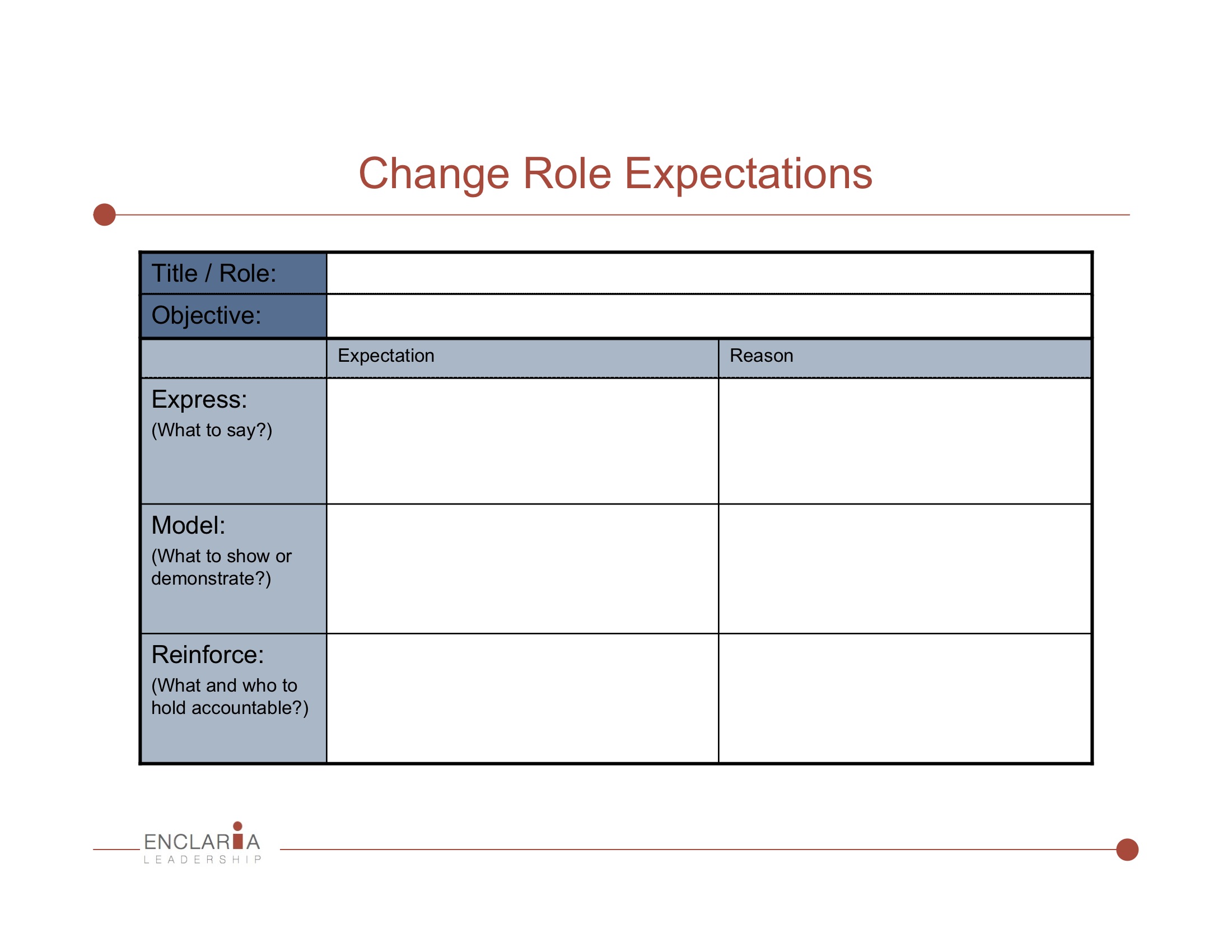
Template: Setting expectations for key change roles
September 24, 2008
One of the toughest parts of a change effort is to influence other people in the organization, especially managers, to speak and behave in ways that move the initiative forward. Frequently, we communicate the vision and hope that managers take up the flag and continue to march faithfully toward the destination. For a few that methodology may work; however for most there is a disconnect between their daily activities, behaviors and attitudes and the change that is desired. We need to train them on three key things they should be doing. For each key role, identify the expectation and the reason for each of the following:
- EXPRESS: What are the key messages that they need to consistently communicate?
- MODEL: What behaviors should they make sure to perform themselves? What attitudes do they need to portray?
- REINFORCE: What behaviors and attitudes do they need to reward or hold others accountable?
Download a worksheet template, which includes an example. Feel free to copy the template for your own use; the only stipulation is that you provide feedback on how it worked, and what you added or removed to suit your own change initiative.