Monitor Your Organization’s “Non-Verbal” Communication
February 23, 2010
It is widely cited that verbal communication makes up only 7% of a total message during a conversation. That is, 93% percent of the meaning within the conversation comes from outside the words that we use. These non-verbal aspects of communication include gestures, posture, intonation, and facial expressions. It turns out the concrete language is by far the least important factor in our interpretation and understanding of what the other person saying.
A similar phenomenon happens in organizations. Consider that the equivalent to verbal communication in organizations are the formal words that come to employees in the form of official documents: values and mission statements, strategy, policies, newsletters, websites, announcements, press releases, and other communication devices. The rest of internal communication comes from everything else employees experience. Similar to a conversation, the vast majority of meaning and understanding is generated by “non-verbal” communication.
The following are examples of “non-verbal” communication in organizations that speak louder than words:
Accountability
Employees assess which policies count and which ones are merely guidelines based on how consistently they are enforced. Processes and procedures are generally followed to the extent that they are required.
“Everyone must contact the IT helpdesk to resolve computer issues”
(unless you know who to call to avoid waiting).
Rewards
Rewards in all their forms tell employees how to be successful. Traditional incentive programs signal expectations but may conflict with stated values or even inadvertently motivate a different behavior than what is desired. Furthermore, who gets promoted and what behaviors elicit praise send powerful messages about what is expected.
“Safety first!”
(Here’s your efficiency bonus.)
Decisions
How managers spend resources speaks volumes about what they truly value and prioritize. The decisions they make about how to allocate funds and how they spend their own time demonstrates what they believe will lead to success.
“Strategic initiatives are important”
(until we need to cut something out of the budget).
Management behavior
More than anything, employees look at the behavior modeled by management to see if it matches what is officially communicated. The most influential person in this regard is an employee’s own boss. The attitudes and behaviors displayed by people in authority tell the real story of what is expected.
“We value employees’ ideas”
(but not the terrible one you just shared).
Employees will rely on “non-verbal” communication to understand what is expected and to decide appropriate action in the midst of uncertainty. When introduced to news of change, many employees will take the stance, “I’ll believe it when I see it.” It is not enough for them to hear it or read it. It is imperative to monitor your organization’s “non-verbal” communication to ensure that actions and behaviors are consistent with your official change message.
Win a copy of Outstanding! 47 Ways to Make Your Organization Exceptional
February 22, 2010
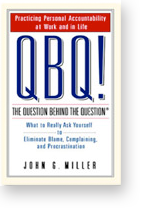
One of the books I believe is required reading for organizational change agents is the wisdom-packed book about personal accountability, QBQ: The Question Behind the Question.
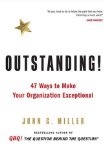
Bestselling author of QBQ and Flipping The Switch, John G. Miller has a brand new book: Outstanding! 47 Ways to Make Your Organization Exceptional.
I told John in last week’s interview on The Change Agent’s Dilemma radio show that with Outstanding! he “had me at hello,” since the dedication of the book says: “To everyone who cares enough to improve the place. You are outstanding!” The book is chock full of stories and ideas of things individuals at all levels can do to improve their organizations. It’s the perfect book for the person who wants to make a difference at work.
While you can purchase the book at Amazon by clicking the book image (affiliate link), I have 5 copies to give away, courtesy of John Miller himself!
There are three ways to enter to win a free copy of Outstanding!:
- In the comments below, tell me how you are making your organization exceptional! (2 copies)
- On Twitter, retweet the following message: “RT @enclaria: Enter to win 1 of 5 copies of Outstanding! 47 Ways to Make Your Organization Exceptional by @QBQGuy: http://bit.ly/ctW2j9.” (2 copies)
- Become a fan of Enclaria on Facebook and post on the wall: “I am Outstanding!”. (1 copy)
Other details: Winners will be selected at random from qualified entries. You may enter using all three methods, and you will only be counted once per method. Each person can win at most one book. Valid e-mail address required. U.S. mailing addresses only.
Entries must be received by Tuesday, February 23, 2010 at 11:59 p.m. Eastern. Winners will be contacted the next day.
How are you making your organization exceptional?
Everyday influence tactics not found in leadership books
February 18, 2010
While setting forth inspiring visions, making bold decisions in support of change, and modeling desired behavior with integrity is the stuff of leadership legend, change ultimately happens in small steps taken daily to nudge people in the right direction. Consider the following influence tactics that people use every day at work that, when used with caution and in small doses, can help get people to do things they might not otherwise do. You won’t find these in leadership books!
Nagging. When someone is dragging their feet or in need of small behavior correction, a few repetitive requests or reminders might do the trick. The risk is that you might become an annoyance and he might dig in his heels further. Before the nagging gets to that level, ask what might be holding him back, and offer to help.
Begging. Although getting on your knees and crying will most likely not win you favor, going the route of “Please… Pretty please… Pretty please with sugar on top…” used occasionally with someone you know will work. It is important for your dignity that you escalate your request with increasing urgency without sounding desperate.
Cajoling. You should only taunt someone you know well and in good humor. The last thing you want to do is hurt someone’s feelings or offend him by striking a nerve, so cajole coworkers with caution. But, insinuating that your colleague doesn’t want to try something because he is a sissy, or is not smart enough, or whatever he would want to prove wrong might spring him into action.
Bribery. While it sounds illicit, bribery is simply offering something in exchange for what you would like the other person to do. Mutual back-scratching or trading favors are common ways to influence someone who doesn’t believe the value of performing an activity is worth the effort to do it. Note: Do not offer or request anything illegal or unethical!
Flattery. The saying goes, “Flattery will get you nowhere,” but anyone who has been given a well-placed acknowledgment or compliment knows it can go a long way. Of course, someone will see through a compliment given just before a request is made. She will know you are buttering her up. But if you can brighten someone’s day with a genuine acknowledgment, she is bound to repay it.
Threats. As a last resort, it might help to inform someone that if she doesn’t play along, something bad is going to happen. The manner in which you send this message makes all the difference. It’s most effective if it sounds like a kind warning instead of intimidation. If your next course of action is to get her boss involved, it might be a good idea to bring this up, so she has the opportunity to act before that happens.
When have these worked for you?
How have they backfired?
What would you add to the list?
Interview: Make Personal Accountability a Core Value
February 16, 2010
This morning I interviewed John G. Miller, bestselling author of QBQ: The Question Behind the Question and Flipping The Switch as well as the new book Outstanding! 47 Ways to Make Your Organization Exceptional, on my biweekly radio show, The Change Agent’s Dilemma. The topic was “Make Personal Accountability a Core Value Using the QBQ.”
During the show, John shared his methodology for eliminating blame, complaining and procrastination. He also talked about the two myths of accountability and much more!
Listen here (30 minutes):
If you are a podcast listener, you may also subscribe to The Change Agent’s Dilemma on iTunes.
Use logic modeling to check your assumptions
February 13, 2010
Yesterday I attended a meeting of the Association for Strategic Planning Atlanta chapter. The presenter was Tom Chapel, Chief Evaluation Officer for the Centers for Disease Control and Prevention. His job is to make sure all the programs designed and implemented by the CDC actually cause the results they are intended to cause.
The example he used during the presentation was a program to reduce lead poisoning in children. In his core diagram were the activities done by the CDC and others in the community, such as Conducting Screenings, Identifying Children with Elevated Lead Levels, and Training Parents. These were all the things under the control of the CDC and its partners.
On the right side of the diagram were all the intended outcomes the activities were expected to influence, such as Changes to Cleaning Habits, and Reduced Lead Levels. One of the shorter-term results was a change in at-home behaviors of parents, and the longer-term effects were the health benefits. Each of the activities and outcomes were connected by arrows in cause-and-effect linkages. He called the diagram a logic model, since it showed the assumptions, or logic, behind how the program was expected to work.
The generic logic model looks like this:

The same type of diagram can be used to model the expected outcomes of organizational change activities (in fact the speaker mentioned that the CDC has done logic models for internal initiatives like diversity and leadership development). The Control side would contain all the activities you are implementing, such as various communication vehicles, incentives, and training programs. On the Influence side would be all the behaviors, attitudes and culture changes your activities are expected to elicit.
Once you create the logic model, you can test your assumptions. Will Activity A really cause Behavior B? What reinforcements might be required? What other factors might stand in the way? In his presentation, Mr. Chapel said to look for where the miracles are supposed to happen and unravel them.
The purpose of the logic model is to gain clarity about the relationship between activities and their intended effects. Over time, by measuring the activities and outcomes, you can test the logic model to see if it’s true.
What are your assumptions about how your change initiative will create its intended outcomes?
Knowing when to quit
February 11, 2010
Inevitably, when I coach change agents the conversation at some point turns into a career discussion. When you are banging your head against the wall, it is natural to consider that the organization is truly unchangeable, and perhaps it’s time to give up.
At the heart of the decision to stay or quit is a question. Is the organization really stuck, or have you just not tried the thing(s) that will work to make it unstuck?
In my experience, an organization is only truly stuck if someone with authority wants it to be stuck. I don’t mean that the senior leaders say they want change but unconsciously sabotage the effort. When that happens there is still an opportunity to hold up a mirror to show them what is going on. No, the organization is only stuck if the CEO (or equivalent) says to you, “We are ending this initiative.” In every other case there is something else you haven’t tried yet.
Consider this: when you are banging your head against the wall, the proverbial wall may not be the immovable organization. The wall might be your own internal barrier that is keeping you from trying the thing that will work. Whether it’s one of many available fears, or conflicting priorities, or imaginary or real inadequacies, an internal barrier may stop you from even considering something that might otherwise be an obvious step forward. If such an internal barrier exists, quitting now in the hopes that another organization will be easier to change will most likely end at the beginning of a similar cycle of frustration.
So go. Go until someone tells you to stop. Otherwise you’re stopping yourself.
What is the wall you’re banging your head against?
If you don’t know what is stuck or don’t know how to get unstuck, contact me to learn how we might figure it out together.
Ten Essential Tools for Change Agents
February 2, 2010
Change agents are individuals within organizations who influence change without having direct authority over people who are going through the change. The following are ten things that effective change agents use to influence change in their organizations. Read more