Don’t mow the weeds
April 29, 2009
This spring, it’s becoming obvious that we haven’t been taking care of our lawn. The weeds have taken over and the grass seems to be hiding.
The instinct is to mow. Just cut the weeds so we don’t see them any more. But if we do that, not only will the weeds not be gone, but they will multiply. It’s the easy fix.
Instead, we have to spray the weeds, and wait patiently for them to shrivel up and turn brown. Then, we can mow and hope that the grass grows up in its place. The lawn looks worse in the interim, but it’s the best way to nurture the lawn in the long run. The only other alternative is to dig everything up and start over again.
In organizations, it’s tempting to find the easy fix. It gives the illusion that the problem has been solved quickly and you can move on to the next challenge. However, lasting change requires time and patience. The real lasting solution may take some waiting and even getting worse before you see results.
Inquiry: Where in your organization have you mowed the weeds?
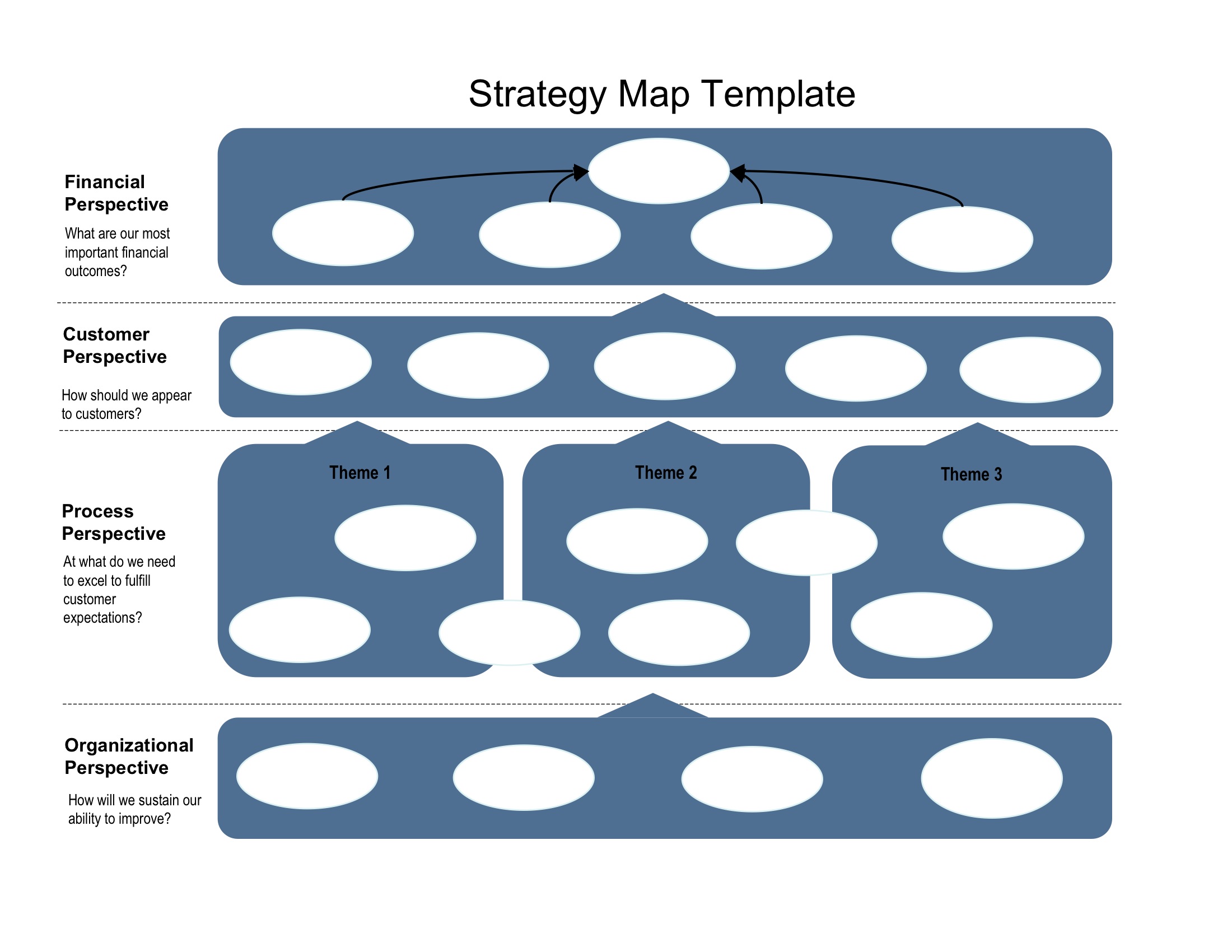
Strategy Map Template
April 24, 2009
It’s been a while since I’ve posted a template. I’m in the process of helping the Organization Change Alliance with their strategy map, so I thought I would post the generic template we started with.
A strategy map is a one-page visual representation of an organization’s strategy. It originates from the Balanced Scorecard methodology, so it consists of the four BSC perspectives: Financial, Customer, Process, and Learning/Growth. The “bubbles” are placeholders for objectives – individual pieces of the strategy, like “Maximize marketing effectiveness” or “Create enthusiastic customers.” The objectives answer what success looks like from each perspective. Themes, usually in the Process perspective, are groups of objectives with the same general, well, theme.
The template is in PowerPoint format. Feel free to modify as you wish, and contact me if you would like some help.
As someone with an interest in Balanced Scorecard, you may also be interested in:
- Case Study: A Fizzled Balanced Scorecard Implementation
- Tips for Leading a Successful Transformation
A measurable definition of culture
April 21, 2009
Until now, the best definition I had heard for Culture is “the way we do things around here.” While that provides a good idea of what culture means, it leaves it difficult to measure.
On Sunday, Andy Stanley at North Point Community Church defined Culture as the collective conscience of a group: The ought to’s and the ought not’s. In other words, the culture is the collection of behaviors that the members of a group generally believe you should and shouldn’t do.
The new definition provides a way to measure a culture as the aggregation of acceptable and unacceptable behaviors. When you can measure something, then you are able to deliberately change it.
Consider whether the following behaviors are acceptable or unacceptable (or ought to or ought not) within your organization:
- Sharing ideas or feedback outside the “chain of command”
- Holding peers accountable to deadlines or performance
- Celebrating team successes
- Bringing your kids to work when no one can watch them
- Playing practical jokes
- Working on a team outside your area of expertise
- Texting or typing during meetings
- Letting a female coworker have the last seat at the table
- Hosting competitions between employees
- Deference to titles
- Lending a helping hand when a coworker suffers a hardship
- Showing up late to meetings
- Working independently on a project
Of course, these are just the tip of the iceberg. Each organization has its own quirks and implied necessary behaviors.
Inquiry: What ought members of your organization do or not do?
For a useful assessment, check out the Organizational Culture Inventory (OCI). I haven’t used it in practice, but I remember using it for an exercise during my MBA program years ago.
The fear of implementing change
April 14, 2009
In the Beyond Buy-in workbook, one of the 5 steps to raising leadership support for your change initiative is to Diagnose the Gap between each leader’s current actions and behaviors and the ones you would like them to demonstrate to better support your change initiative. There are a number of places to look at what causes the gap, and one of them is fear.
Yes, not only do people in general “fear change,” but even leaders have fear of implementing change. Consider these common fears:
- Failure
- Looking stupid
- Being wrong
- Rejection
- Not being good enough
- Being judged
- Losing popularity
- Inferiority/Not as good as everyone else
- Helplessness
- Damaging relationships
- Letting people in
- Being challenged
- Being ignored
- Success!
Thank you to my Twitter friends for their contributions. Please add to the list using the comments below.
Inquiry: What fears do you have about implementing your initiative?
Free Webinar April 16: Beyond Buy-in
April 9, 2009
I’ve found through my conversations with organizational change agents that one of the most common challenges is getting individuals – usually peers or superiors – to do what needs to be done to make change happen.
Does this sound familiar?
The head of another department is not responsive to my requests.
An executive is not communicating the change properly, and it’s diminishing the message.
The CEO insists on maintaining an environment that is not conducive to the changes we should make.
Join me for a free webinar that shows you 5 steps to gain leadership support for your change initiative – through their words and actions.
Beyond Buy-in: Raise Leadership Support for Your Change Initiative
Date: Thursday, April 16, 2009
Time: 3:00 p.m. to 4:00 p.m. Eastern
Space is limited. Please register to reserve your spot and receive log-in details.
Four strategies for making change
April 4, 2009
I just finished reading an interesting article in Time Magazine: How Obama is Using the Science of Change. The article discusses “behavioral economics” being used by the administration to help us make better decisions. It lists four strategies to get people to alter their behavior:
- Make it clear – provide better information
- Make it easy – ultimately, make the desired behavior the default one
- Make it popular – show that everyone is doing it
- Make it mandatory – enforce rules, or make it so appealing no one would say no
While the context is politics and economics, the ideas in this article are easily applied to organizational change. Read it, then answer this question:
Inquiry: How can you make your change clearer, easier, more popular, or mandatory?
Please share your thoughts with a comment.