Make your organization road-ready
July 26, 2009
If you're new here, you may want to subscribe to my RSS feed, or sign up for my newsletter ==>
to receive the free Change Starts Here Workbook. Thanks for visiting!
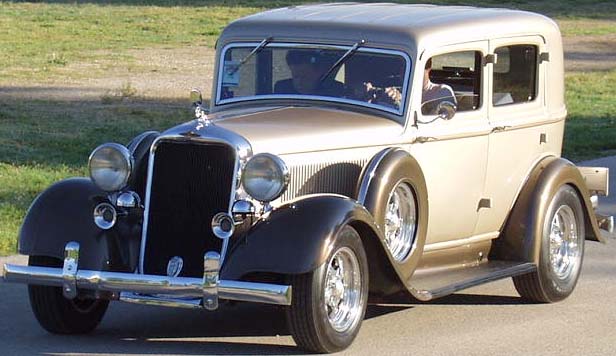
I saw an antique car in a parking lot today. Just quickly browsing on the internet, it looked like an American model from the early 1930’s (like this 1933 Dodge photo I found on carnut.com).
I started to wonder what it would take to make a car like that road-ready based on today’s standards. How much of the car was original, and how much was reconstructed using today’s technology and materials? Had there been any upgrades to the engine or exhaust, and did it have any hidden but modern features such as air conditioning or a CD player? Did it even have seat belts or any other more modern safety features?
When building an existing organization for the future, we can ask ourselves similar questions.
- What features of the improved organization should be recognizable as the same organization?
- Which aspects do we need to retain to stay true to our purpose and values?
- What parts can we rebuild with new technology and new ideas?
- How do we remain flexible with an eye toward the future?
- What should be overhauled, replaced or augmented based on what we now know works?
- What is required based on new or foreseen standards?
- Do you need to do maintenance, or restoration?
The 76-year-old car I saw was well-kept and shiny. When the owner arrived, it started right up and he drove away.
How might you make your organization road-ready for the future?
Here’s another exercise, because metaphors are incredibly useful for thinking about your organization (or anything else) in new ways, and discovering ideas and insights that might otherwise be left undiscovered.
Take a look at the picture of the antique car and ascribe parts of the car to features of your organization, department, process, etc. Then use that association to consider the questions above. Take the headlamps as an example:
What do the headlamps represent? Our strategic planning process.
What is required based on new or foreseen standards? The lights need to be brighter than before. So we can see the road clearly, plus what is not on the road but headed straight for us.
What parts can we rebuild with new technology and new ideas? The amount of information available to us is increasing. We need a better way to process it all and make sense of it.
You get the idea.
Game changing performance
December 30, 2008
During the Alamo Bowl, Missouri vs. Northwestern (my alma mater), there was a commercial for the Pontiac Game Changing Performance of the Year. It is a contest in which participants vote for NCAA football plays that altered the course of a game. All the plays they showed were last-minute miracle touchdowns.
The game-change concept implies that what was once inevitable – that one team would win – suddenly was not. When the score keeps going back and forth, the last one to score wins. The game changing performance happens when the odds are against the current underdog, but because something special happens, the odds are overcome. It’s the moment when those who still had hope rejoice and those who had turned off the television because of the expected outcome awake the next morning in dismay that they had missed the turn of events.
With organizational change, the game changing performance might be more subtle; however the concept is the same. While it seems that the status quo might be the inevitable outcome, suddenly one activity, initiative or event happens that tilts the scales toward the new direction. Perhaps that event is a meeting, or a conversation. Maybe a communication campaign hits the mark, or a key project is completed with expected results. It could be that an external event occurs that spikes the organization’s urgency level.
Like in football, you can frequently name these events ahead of time. Sometimes you need a miracle touchdown, so you pull out a play from the playbook that might end with that outcome. Other times you can only hope for a chance interception returned for a goal.
Inquiry: What might be your game changing performance?
Northwestern lost in overtime, 30 to 23. That miracle pass was intercepted. Better luck next year!
The Penny and the Freight Train
November 21, 2008
One of the most common metaphors for the status quo organization is the runaway freight train. Without anything that can stop it, the train simply continues to barrel forward along its tracks. Unfortunately, the desired destination is not at the end of those tracks, but the sunny green pasture off to the side.
Enter the penny. Mythical for sure, it is thought that a single 2.5 gram penny, when placed strategically on the tracks, can derail a freight train. Just a small blip in the track and the train is launched off its otherwise inevitable path.
Inquiry: What is your penny?
Now you might be thinking that the end result of the above scenario is either a squished penny or a mangled mess of flaming steel. If so, instead of seeing the penny as a catalyst of change, you see it as a precursor of destruction.
Inquiry: What lies at the end of the tracks?