Game changing performance
December 30, 2008
During the Alamo Bowl, Missouri vs. Northwestern (my alma mater), there was a commercial for the Pontiac Game Changing Performance of the Year. It is a contest in which participants vote for NCAA football plays that altered the course of a game. All the plays they showed were last-minute miracle touchdowns.
The game-change concept implies that what was once inevitable – that one team would win – suddenly was not. When the score keeps going back and forth, the last one to score wins. The game changing performance happens when the odds are against the current underdog, but because something special happens, the odds are overcome. It’s the moment when those who still had hope rejoice and those who had turned off the television because of the expected outcome awake the next morning in dismay that they had missed the turn of events.
With organizational change, the game changing performance might be more subtle; however the concept is the same. While it seems that the status quo might be the inevitable outcome, suddenly one activity, initiative or event happens that tilts the scales toward the new direction. Perhaps that event is a meeting, or a conversation. Maybe a communication campaign hits the mark, or a key project is completed with expected results. It could be that an external event occurs that spikes the organization’s urgency level.
Like in football, you can frequently name these events ahead of time. Sometimes you need a miracle touchdown, so you pull out a play from the playbook that might end with that outcome. Other times you can only hope for a chance interception returned for a goal.
Inquiry: What might be your game changing performance?
Northwestern lost in overtime, 30 to 23. That miracle pass was intercepted. Better luck next year!
Remove barriers with Theory of Constraints
December 23, 2008
The Theory of Constraints (TOC) is a model originally developed by Dr. Eli Goldratt and made famous in one of the most-read manufacturing books, The Goal. Last week I attended a presentation at the Organization Change Alliance by Dr. James Cox, retired professor at University of Georgia Terry School of Business, who has worked directly with Dr. Goldratt and is one of the leading experts on TOC. He brought to light a concept rooted in industrial engineering as an organization change methodology.
The Theory of Constraints says that in a production system, to improve efficiency, find the weakest link – your constraint – and then maximize its performance. Keep that step in the process busy at all times to maximize output for the entire process. Next, modify that step so that it is no longer the constraint. When the next constraint pops up (because there will always be one), then maximize it until you can eliminate it.
The thinking process used to eliminate barriers was presented as a way to implement change. Despite the 2-hour presentation, he was only able to skim the surface.
The TOC thinking process consisted of three major steps:
- What to change
- What to change to
- How to cause the change
What to Change
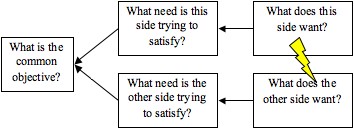
Dr. Cox defined that a constraint is “anything that blocks or limits one from achieving its goal.” One of the tools used to find what to change is the “Evaporating Cloud.” He showed us the following diagram:
The purpose of the Evaporating Cloud is to identify a conflict, or barrier, to reaching the objective. The “needs” are both required to satisfy the objective, but the “wants” cannot coexist. Take this example of a barrier to patient care in a hospital emergency room:
To maximize patient care in a hospital emergency room, patients must not wait long to see the doctor, and once they see the doctor, patients need focused care – however long it takes. These two “needs” are satisfied by two conflicting “wants:” to spend time with patients and to have quick patient visits.
What to Change To
To determine what to change to, solve the Evaporating Cloud by challenging all the underlying assumptions (until the cloud evaporates). For example:
- How might the “wants” coexist?
- What other ways can the “needs” be satisfied?
- In what other ways might the objective be achieved?
How to Cause The Change
One of the methods Dr. Cox presented on determining how to cause the change was the Prerequisite Tree, also known as the Ambitious Target Tree. Given a desired future state, ask “Why can’t we do that?” Next, map out ideas to overcome all the obstacles. After that, ask, “If we eliminate all these obstacles, can we do this?” If not, continue building the tree until all barriers are mapped.
There are a number of other TOC thinking processes that were briefly mentioned. Wikipedia contains a complete list.
Lone oak tree
December 17, 2008
When I look out the window in my home office, I look straight at a massive oak tree that stands in someone else’s backyard a few houses away.

It strikes me that some master planner 12 years ago decided that, while everything else in the vicinity was to be clear cut to make way for our neighborhood, this oak tree (and the pine tree directly behind it) was worth saving.
I wonder what it was that made the planner save the tree. Was it a practical decision – the tree was just too large to cut down economically? Was it a sentimental decision – the tree had been there so long it just had to stay? Was it luck – since the tree grew exactly in that spot it didn’t need to be cut down in order to build the homes around it? Or was the tree simply unique – a treasure found amid a forest of seemingly ordinary pine trees?
When planning for change, it is easy to have the mindset of looking for things that need fixing. It’s equally important to watch out for things that you can and should save.
Inquiry: What is your oak tree?
Little blue notebook
December 11, 2008
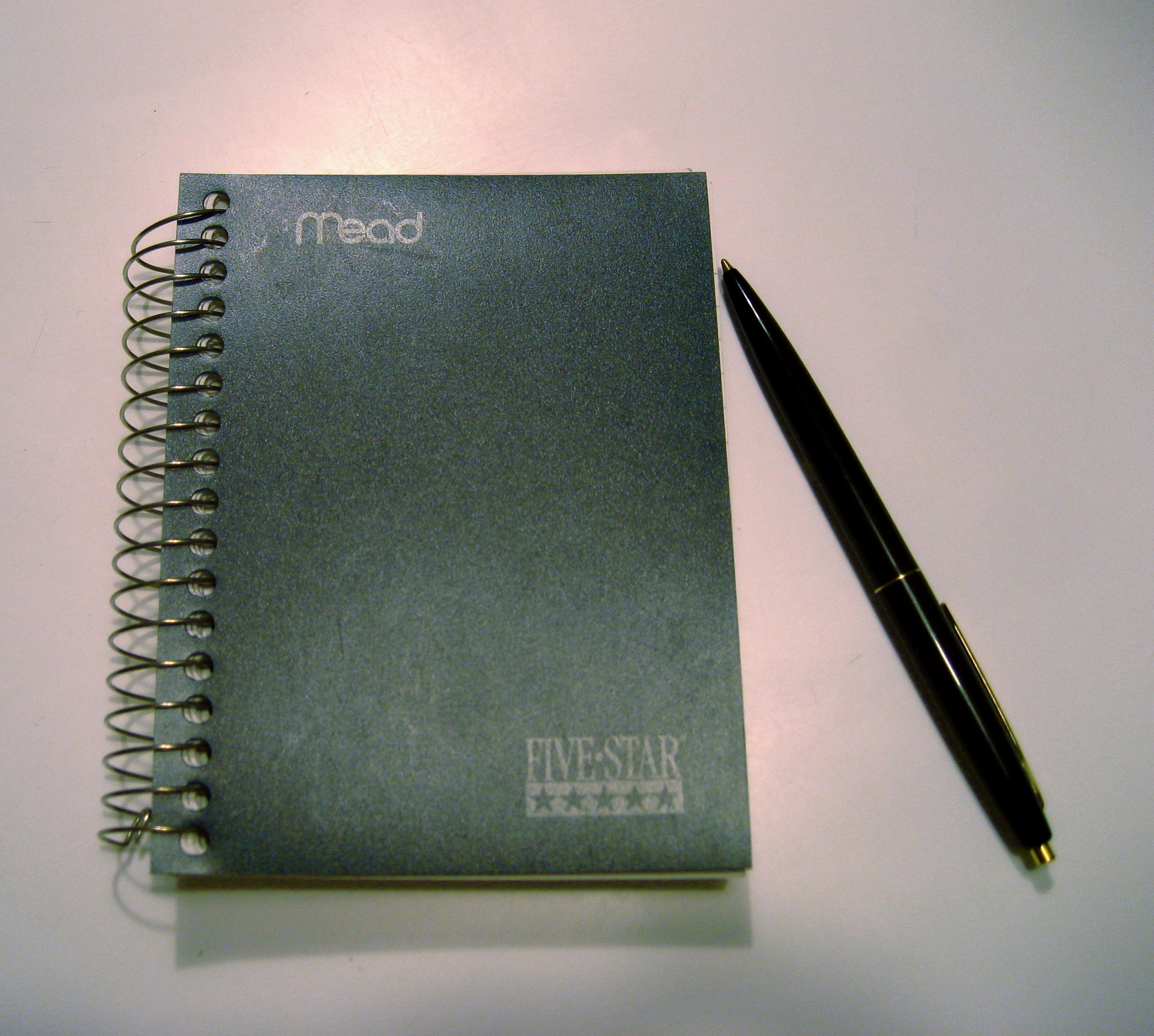
When I was a fledgling change agent, I kept a little blue notebook hidden in my purse. It was a Mead Five-Star Fat Lil’ Notebook. Inside were one-page observations, comments, quotes and complaints that reflected what I felt needed to be fixed at the company where I worked. It’s probably a good thing that blogs hadn’t been invented yet.
I still have it. Here are a few excerpts:
CULTURE
Lack of follow through. We are good at identifying problems but frequently push them aside to focus on other things. Sometimes we even know the solution and don’t follow through.
INCENTIVES
Sales managers are given a bonus based on accuracy of the total number of cases. The customer of the forecast is the planning department. Total number of cases does not help them plan better. Reward the desired behavior – some measure of SKU or category forecast accuracy.
LEADERSHIP
No one can say anything in front of [name]. He should not be the end of the line final decision maker. Does he know people are closed-mouthed around him? His decisions sometimes are reversed at meetings he doesn’t attend.
STRATEGY
What is our strategy? To sell to anyone who will buy? Why are we not more discriminating in what we sell? What is the process that makes us continue to try to sell every combination of goods?
The notebook served a few purposes.
- A record – it’s easy to lose sight of things that need to be fixed when you either get used to them or move on to something else. Writing it down preserves the memory, and you can go back and count the number of instances something is mentioned to measure its importance (forecast accuracy was a big deal).
- An outlet – you can tell by the tone of some of the comments that I was mad or annoyed. Writing was a way to vent the negative emotion. It can also help clarify what is the crux of the problem.
- An integrity-keeper – writing down your thoughts privately can help you refrain from complaining to others. According to The Transparency Edge, one of the books in my reading list, one way to destroy your integrity is with unproductive criticism or complaining. (Of course, if someone had found the little blue notebook, that would have been another story.)
Granted, I was not able to fix everything on the list, but I was able to take a stab at some of it. And that’s really my point. Don’t keep a journal like this just to document the list of everything you don’t like about your company. Write with the best intentions to take action and improve the important things.
Inquiry: What’s in your little blue notebook? What are you going to do about it?
My True North Story
December 9, 2008
I just submitted an entry to www.truenorthsnacks.com/story – a contest to have an TV ad created and played during the Oscars featuring your True North Story. Entries are limited to 300 words. Here’s mine.
My name is Heather Stagl, founder of Enclaria, LLC, where I equip individuals to lead organizational change. In my 11 years in corporate America, I learned that true leadership does not manifest itself only at the top of an organization. I’ve made it my mission to help people at all levels make a difference – to improve their job and make their company a better place to work for their colleagues.
I started my career as an industrial engineer and soon discovered that even a well-designed system will not work without accompanying leadership to sustain the change. The more I learned about leadership and change management, the less I liked my work environment, but I loved the people I worked with and had hope it could be better. I did my fair share of complaining, and then decided to do something about it. Using my MBA program as an excuse to perform a study, I was able to show the leadership team ways we could improve the organization. I was invited to facilitate strategy sessions and to lead one of the key initiatives that came out of it.
In the middle of this journey, I was introduced to coaching. I discovered during the coaching training classes that I was a natural. I realized that helping people find clarity was something that I had done most of my life. People always seemed to seek me out to help them think through problems and apply logic to find solutions.
Despite my successes, I still feel that there is so much more that I could have done, if I only had the courage and determination to tackle it. I don’t want anyone else to feel that they could have done more to transform their organization.
New Teleclass! Beyond Buy-In: Raise Leadership Support for Your Change Initiative
December 5, 2008
Starting this month, I plan to start a series of monthly teleclasses. The objective is to bring like-minded individuals together to learn about and discuss how to overcome common challenges to organizational change.
Earlier this year, I published two articles: Eight Fundamentals of a Successful Change Initiative and Common Challenges of Organizational Change. One overlapping theme was building leadership buy-in and support for the initiative. I thought this would be a good place to start our conversation.
Teleclass Details
Beyond Buy-In: Raise Leadership Support for Your Change Initiative
Date: Tuesday, December 16, 2008
Time: 12:00 p.m. Eastern
Leadership is overrated
December 2, 2008
Now that probably sounds like a crazy statement to make when you’ve called your business Enclaria Leadership. More about that later…
Don’t misunderstand me. Leadership is important; however, it is the means, not the end. I’ve read about and studied Leadership for while now and much of the time this fact is overlooked. The goal is lasting, meaningful, necessary, challenging improvement – aka change. Leadership is a necessary but not sufficient component of a transformation initiative. It’s time to turn off the background choir and fuzzy glow every time the word is mentioned.
The fact remains: In order to change their attitudes and behaviors in a cohesive manner, people need someone whom they trust to show them the way, motivate them, and eliminate barriers.
The person who steps up to do so is a leader, whether he or she is an executive, a department manager, or simply someone who believes a change is warranted and takes action. It’s a tall order, and one that is both voluntary and earned. No one will argue that Leadership is not imperative to implement change.
At the same time, Leadership is not the only necessary component required to transform an organization. The tools for transformation are found in “show the way,” “motivate,” and “eliminate barriers.” These are the vision statements and strategies, the communications plans, the incentives and the management systems. These are all necessary pieces of organizational change that need to be executed well to achieve results. Without these, your change initiative will fall flat.
The Leadership component in the statement above is “trust.” When we consider whether to follow someone, he receives a higher level of scrutiny on the trust factor. Is he credible? Is she consistent? Does this person respect my ideas? Does he know what he’s doing? Can I believe what she says? With such high standards, it is easy to see how Leadership creates heroes and villains. Placed on such a pedestal, Leadership turns into a theoretical concept whose attainability is out of reach.
Personally, I hold the belief that if you have noble intentions and have the courage to step forward to make a difference, with a lot of effort and a little guidance, and using all the tools at your disposal, you can make it happen. My aim is to equip people like yourself to lead organizational change. So, when you work with Enclaria, you will definitely spend time working on leadership issues – things like style, vision, communication, influence, integrity. Since leadership is only one of the many tools that we can use to achieve lasting transformation, the name of my business is now Enclaria, LLC.