Template: Setting expectations for key change roles

September 24, 2008

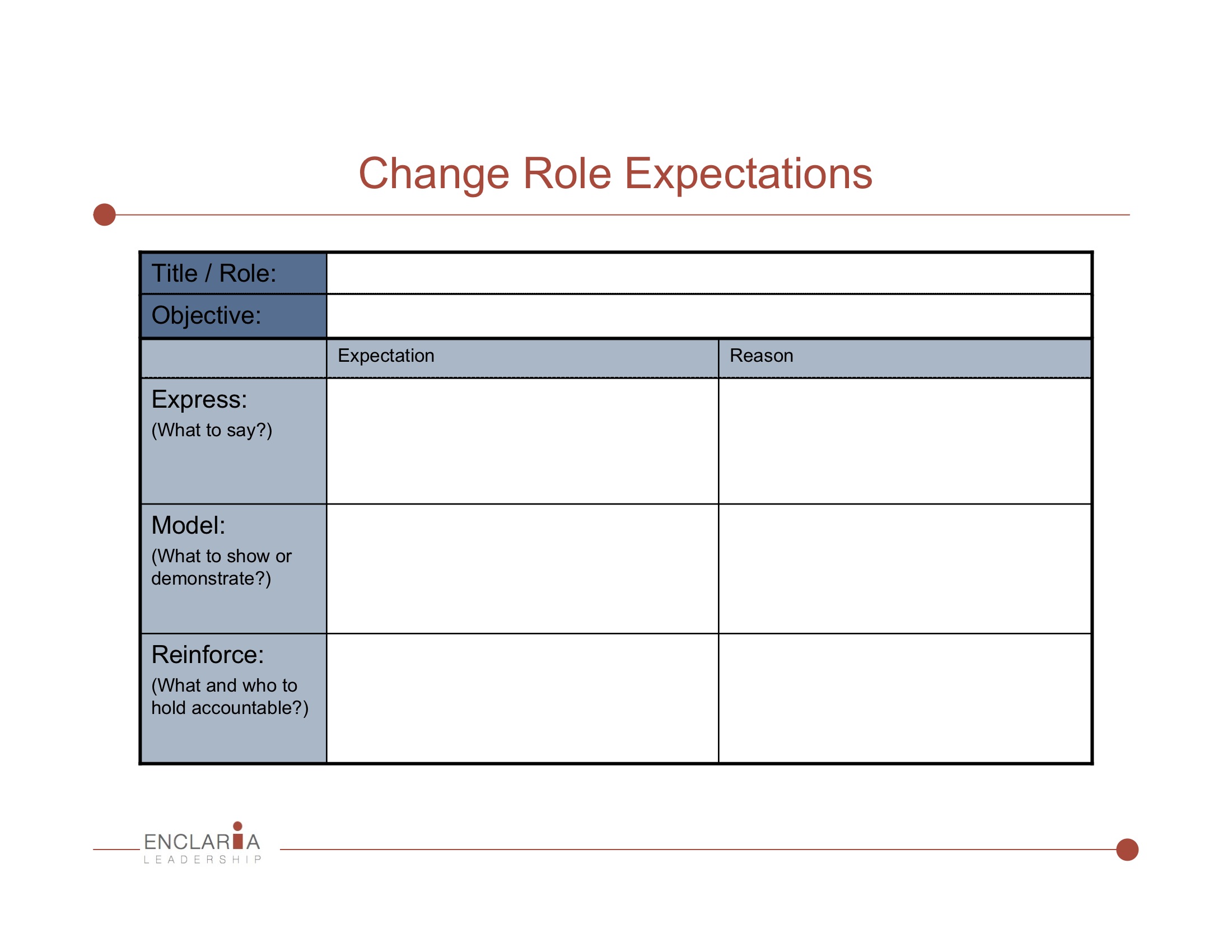
One of the toughest parts of a change effort is to influence other people in the organization, especially managers, to speak and behave in ways that move the initiative forward. Frequently, we communicate the vision and hope that managers take up the flag and continue to march faithfully toward the destination. For a few that methodology may work; however for most there is a disconnect between their daily activities, behaviors and attitudes and the change that is desired.  We need to train them on three key things they should be doing.  For each key role, identify the expectation and the reason for each of the following:

  1. EXPRESS:  What are the key messages that they need to consistently communicate?
  2. MODEL:  What behaviors should they make sure to perform themselves?  What attitudes do they need to portray?
  3. REINFORCE:  What behaviors and attitudes do they need to reward or hold others accountable?

Download a worksheet template, which includes an example.  Feel free to copy the template for your own use; the only stipulation is that you provide feedback on how it worked, and what you added or removed to suit your own change initiative.

Assessment: Personal and Professional Satisfaction

September 15, 2008

The Coaches Training Institute has created these “Assessment Wheels,” which measure your level of satisfaction with different aspects of your life.  So often, we focus on one or two aspects of our lives while ignoring others.  The Assessment Wheels give you the opportunity to evaluate whether other parts of your life need attention.

In coaching, the wheels are often used as a starting point for the conversation.  They are not meant to be a comprehensive evaluation of your life, but are designed to give you food for thought for how you might use a coach to improve your life, personally or professionally.

Personal Assessment Wheel

Professional Assessment Wheel

These assessments are posted with permission from The Coaches Training Institute.

Employee Survey: Factors That Increase Innovation

September 8, 2008

In an effort to better understand employee innovation, I developed an employee survey to answer the question:  “How can we increase the number and quality of ideas suggested by employees?”

The survey was developed based on a model for increasing employee involvement*, which includes four elements:

  1. Power: For employees to become involved, they need to have the power to do so.  In the case of submitting ideas, employees need to feel that their ideas will be considered, will be valued, and will be implemented.
  2. Information: Employees need timely access to relevant information in order to know best how to focus their creative efforts.
  3. Knowledge/Skills: Employees can only contribute to the level of their knowledge and skills.
  4. Rewards: In order to be motivated to contribute, employees need incentives, either internal or external.

The results of the survey helped design an improved suggestion box program, which increased the number of ideas suggested by a factor of nine.  See the post “Case Study: A Roundabout Path to Increasing Employee Suggestions.”

Given the chance to redesign the survey, I would have mixed up the categories more so they would not be grouped together.  Also, it would have been a good practice to make more questions inverted, to reduce bias in the questionnaire.  Overall, the survey provided us with good information from which we were able to take action and make a measurable improvement.

* Source:  Cummings and Worley, Essentials of Organization Development and Change, South-Western College Publishing, 2001, pg 172-173.

Hear the latest episode of The Change Agent’s Dilemma:

Let’s Connect!

Follow me on TwitterConnect on LinkedInBecome a Fan on FacebookEmail me

Free 30-Page Workbook!

Sign up for the monthly newsletter and get the Change Starts Here Workbook!
Email
First Name
Last Name
See preview. View the privacy policy.